Showing posts with label training. Show all posts

Sunday, 14 October 2012

Mediation Skills Training Course at the Bar Council - 3rd Oct until 7th Oct 2012

Mediation Skills Training Course October 2012
Mediation - role play in session
Mediator "mirroring" one of the parties
"Mirroring" in action
The wonderful participants
Mediator setting the Agenda
Me and Faizal
Last week was a very busy week for me. I was asked by the Malaysian Mediation Centre (MMC) to be the Course Leader and the Lead Trainer for a 5 days Mediation Skills Training Course at the Bar Council, Malaysia. The course ran from 3rd October until 7th October 2012. The thing I like about the MMC is that they give you a free hand to run the course as you deem fit. I decided to rope my colleagues and friends to help me out in the Mediation Skills Training Course. All of them are Certified Mediation Trainers and like me, we are all doing it pro bono. We are not paid a single cent. All the monies collected from the Training Course go to MMC for the upkeep and the maintaining of the Centre.

The people who came and helped were Wong Lu Peen (she was there the whole of first day as she already had plans to travel to overseas the following day), Marcus Hwang, Tejinderpal, Puan Hendon (Tejinderpal and Puan Hendon have been helping me since Day 1 of the Course), Serene, Chan Kheng Hoe, Nacha, Sumathi, KL Choy, Tay Bee Choo and Christine Khor. Serene, KL Choy, Bee Choo and Christine are from outstation. Due to the spirit of volunteerism and camaraderie, they made the extra effort to be with us at the Training.

During the Training, Bee Choo (from Johor Baru) and Christine (from Penang) stayed at my place. After the Training on Day 3, I took Bee Choo, Jennifer, my father and our friend, Catherine Eu (former Executive Director of the Bar Council, Malaysia) to Jinjang (Kepong) to try this unique steamboat porridge dinner. Amongst the dishes was a plate of “live” prawns. The prawns were still moving and active. You have to literally and physically put the prawns into the pot of hot steamboat porridge. You can’t get the prawns any fresher than that. Without a doubt, the prawns were simply delicious. On Day 4, Christine Khor joined us from Penang. Catherine Eu invited us over to her place for dinner but we had a better idea, we asked her to join us for seafood dinner in Port Klang. We went to this place called “Klang Seafood” and had crabs, “sotong”, fried “hokkien mee” just to name a few. It was real fun having Bee Choo and Catherine over at our place.

When it comes to food, I digressed. Let us get back to the Training. We had a wonderful group of people comprising of senior lawyers, marriage therapist, psychologist and a medical doctor as participants. As Puan Hendon remarked in her closing speech, this Training was conducted in a different style compared  to the previous trainings. In this Training, we played games, had short exercises, several role plays and we showed seven (7) different video clips. The clips are fun videos featuring flash mob, baby laughing and also “gang-nam style”. We wanted to keep the Training exciting and lively for the participants. It was our intention get them on their feet and keep them moving. We even had a “set-up” sketch where my secretary, Michelle Martin played the role of the “rude lady” who kept on interrupting me while I was conducting the Training. It was all done in good fun with a specific purpose. If you want to know the purpose, come and join us in the next Training.

Besides having fun, the Training was also quite a personal challenge for me. On the last day, I had food poisoning and was throwing up. Later on, I discovered that a number of participants also experienced the same thing. However, as they say, “the show must go on”. I am thankful to Bee Choo, Christine and a few others who were constantly checking on me throughout the day. My thanks also go to Marianna Tan and Faizal who showed genuine concern. They are from the Malaysian Mediation Centre and have been a great help throughout the Training. In that Training, I also took my final bow as that was my final training given as a member of the Malaysian Bar. A lot of nice memories and I made a lot of good friends. Thank you everyone!

Tuesday, 9 October 2012

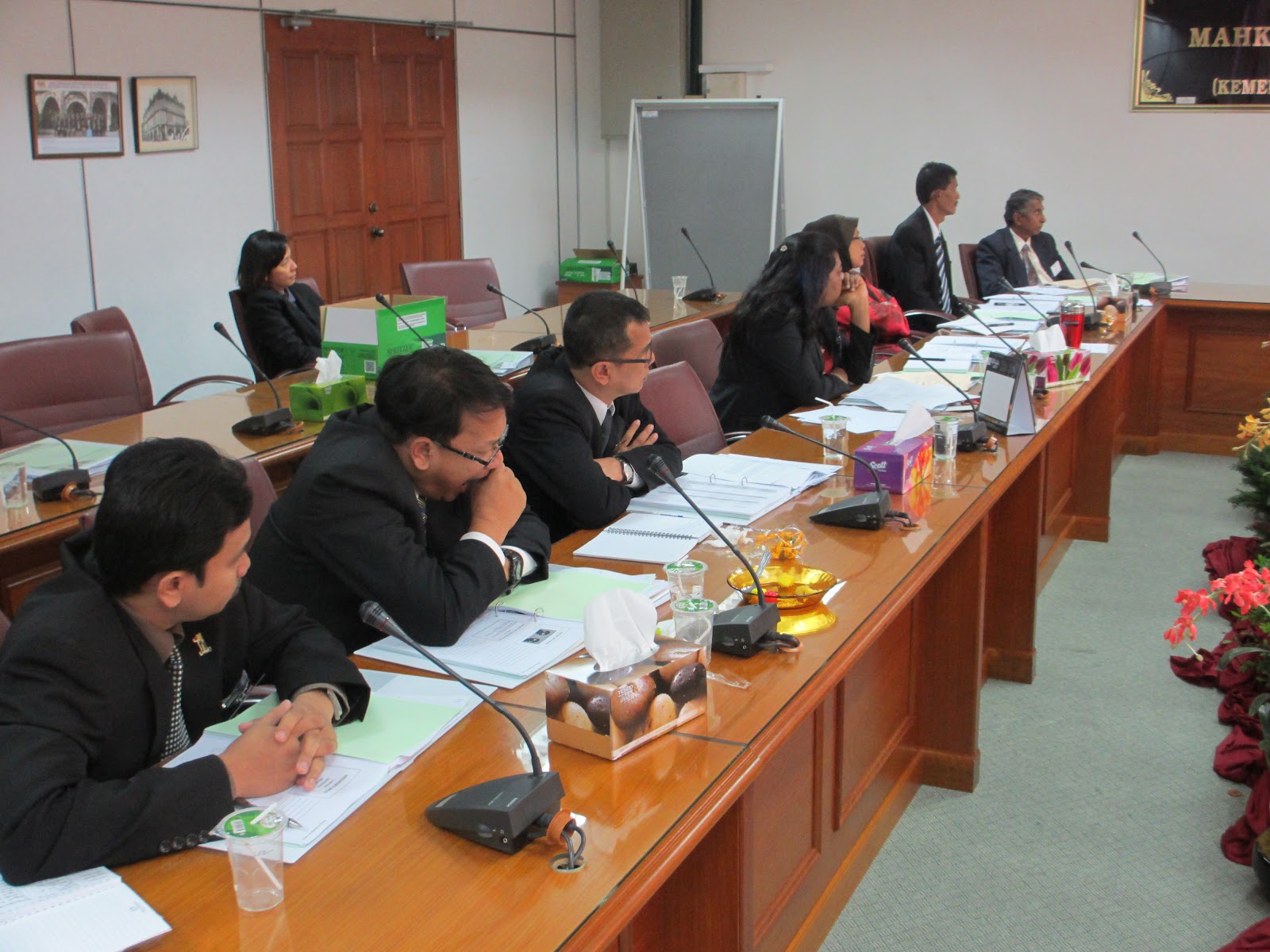
Mediation Skills Training Course at the Industrial Court - 18th -22nd Sept 2012


Distinguished participants


"Mediation Skills and Techniques" book presentation
The Malaysian Mediation Centre (MMC) conducted a 5 days Mediation Certification Course at the Industrial Court, Malaysia recently. It ran from 18th September 2012 till 22nd September 2012. The venue was at the Industrial Court itself in Kuala Lumpur. The trainers were Nacha, Meg and myself. Nacha and Meg did most of the work while I handled the topic on techniques or better known as “Dealing with Stubborn Behaviour”. I informed the participants that I intend to replace the negative word “Stubborn” with “challenges”. Why? Because challenges can be overcome! The participants were made up of the Chairmen and Chairwomen of the Industrial Court (“Industrial Court Judges”), the Registrar, the Deputy Registrar and the Assistant Registrars. They came from Kuala Lumpur, Perak, Sarawak and Johor.

The feedback from the participants was positive. I think most of them enjoyed the course very much. I wish I could share more techniques with the participants but because this  is a Certification course, there were a lot of grounds to cover apart from mediation techniques. As usual, the training would not have been possible without the support of the wonderful coaches like the ever obliging Puan Hendon, the ever friendly and helpful Tejinderpal, the witty Wong Lu Peen, Sumathi and a few others. For the record, the trainers and coaches were not paid. All monies collected go to the MMC fund.

Rachel Tan who is now with Thomson Reuters Malaysia (Sweet & Maxwell Asia) made an appearance with copies of my book. The Industrial Court bought seven (7) copies of my book to be distributed to the various Courts in Malaysia. Thank you so much for the great support. All of us had a great time and hope that we will be able to conduct more of these trainings in the future.

Saturday, 11 August 2012

Using self assessment to gauge a person's level of confidence

I remembered when I was a student at the University of Southern California (USC), my Economics Professor by the name of Dr. De Prano had a strange way of assessing students. He would asked the students to assess themselves by giving themselves a mark ranging from 1 to 100 with 100 being the highest score. If the student gives himself/herself a low mark, say for example a 60 out of 100, the Professor will ask you a relatively easy question. If you answer the question to his satisfaction, he will give you the full 60 marks that you asked for. Sounds fair enough? However, if the student asked for a higher mark, say 90 out of 100, the Professor will ask you a difficult question. If you answer it to his satisfaction, he will give you the 90 marks but if you answer the question incorrectly, you will get a zero (0)! Most students tend to play safe and gave themselves 60 to 70 marks.

However, I remembered there was a student, a rather cocky fellow I might add, joined our class and gave himself a 98 marks rating. We were all stunned. The Professor looked at  the student and gave him a question which I thought was not that difficult. As a matter a fact, it was comparable to a question worthy of 60 to 70 marks. I was curious as to why the Professor acted the way he did. After completing the course at the end of the semester, I bumped into the Economics Professor and commented about being “unfair” and “taken for a ride” by him when he gave a rather easy question to that particular student. The Professor looked at me and smiled. He said when you enter the real world, it is not just how you answer the question but people want to see how confident you are when you deliver that answer or giving that presentation! That cocky student was confident enough to give himself a high mark and managed to project himself in a very confident manner. I thought to myself that was a good was of assessing a person’s self confidence.

More than twenty years later, I became an assessor for the Mediation Skills Training Course at the Bar Council. My duty was to assess the candidate and to determine whether the candidate is suited to be an accredited Mediator with the Malaysian Mediation Centre (Bar Council). Immediately after the assessment, the candidate will normally ask, “How did I do?” Some of my colleagues will be rather polite and inform the candidate, “let’s wait for the result” or “you will know soon enough”. As for me, I will reframe by asking them, “What do you think?” or “how do you feel you did?” I wanted to see whether the candidate is  confident or sincere enough to give himself or herself a fair assessment. When a person becomes a professional Mediator, you have to be confident or at least must be seen to be confident by the parties. Giving yourself a self assessment is a good way of improving yourself. We are not perfect. We do make mistakes but what it is important is that you learned from it and move on. A final note that I wish to add here is that the question I posed to the candidate after the assessment has no bearing on their grade, it was merely to see their reaction, that’s all. I think it is better that I made it clear here in case some of the previous candidates or future candidates are reading this post!

Saturday, 21 July 2012

CTP -A course that teaches you to assess, design, implement and evaluate!


The CTP graduating class - July 2012
Armi Stephanie Trenas - our trainer in course design
Jamal (MACC) and Kirit (UN) doing their presentation on corruption
My group members - Lourdes and Hidayah
The top presenters in our class - Lourdes and Syikin from Dominos
The ever lively Lourdes
Ron and me doing our "NLP Techniques"
Recently, I took a 10 days course called “Certified Training Professional (CTP)” programme at the Institute of Training and Development (ITD) at Plaza Mont Kiara. Upon completion of the course, the participant will be awarded a “Certificate of Achievement” which will enable the participant to be a HRDF (Human Resources Development Fund - a statutory body) trainer. ITD is the only private institute in Malaysia that has been given the privilege of training participants to be HRDF trainers.

What does it mean to be a HRDF trainer? When one becomes a HRDF trainer, the person can conduct in-housing training for companies who are HRDF contributors. HRDF contribution is compulsory for certain categories of companies. Therefore, in order to utilise the funds, the companies can apply to HRDF to use its contribution for payment to the HRDF trainer. A few years ago, I remembered a few companies approached me to conduct some in-house training for them. When I informed them that I am not a HRDF trainer, their offers were suddenly kept in abeyance! Now that I am a  HRDF  trainer, it is time to revisit the offers.

The CTP Programme is a rather comprehensive programme that covers five modules which consist of “The Trainer in the Organization”, “Training Needs Assessment”, “Training Design”, “Training Implementation” and “Training Evaluation”. In summary, it teaches the participants to do a needs assessment (job analysis and competency) to see what is lacking in the area of job performance in the company. Once, the information has been gathered, the trainer will then design a course to address that shortcoming. It is interesting to note that there are people who are specialised in just designing courses. I understand that they are paid a lot of money for doing just that. They used to be called “Course designers”. Now, they have a fancier name, they are called “Instructional Designers”. After designing the course, then we have the implementation stage where we look into the different learning styles, presentation and delivery. The final stage is known as the “Training Evaluation” where the trainer evaluates the training that has been conducted. In other words, measuring the results or benefits obtained by the participants as the consequences of the training.

What I find really useful in the course is that it formulates and gives the participants a systematic approach in doing all of the above -ie: from conducting needs assessment to evaluation. In particular, I find the module on "Training design" really useful and enlightening.

I enjoyed all of the 10 days of the training. I met many wonderful and interesting people coming from the MACC Training Academy (Malaysian Anti Corruption Commission), the Securities Commission, the UN Mission in Iraq, Old Town White Coffee, Dominos and many others. During the training, we were either asked to work in pairs or in groups. I was fortunate enough to pair up with a nice guy by the name of Ron (Ahmad Razlan) where we did our presentation on “NLP Techniques”. The other members in the group were a Filipino lady by the name of Lourdes (who is an excellent singer and a very jovial person) and Hidayah Khalid (a make up specialist). It was great fun working with them.

I also met a few interesting people like Kirit Makita who works with the United Nations Mission in Iraq and like all loyal Japanese, he loves everything Japanese. During his stay in KL, we have gone to the 100 Yen shop numerous times! Kirit and Jamal (from MACC) did a fantastic presentation on reporting corruption as part of their team project. I have also met Mahmoud (a Palestinian who is currently doing his Masters at the Universiti Sains Malaysia) and Bader who is from Oman. We have also tasted beautiful “2 in 1 coffee” courtesy of Queenie (Old Town White Coffee). We have got our Generation Y people like Izzatul and Youlinda who brought youthfulness to the training programme. We also have brilliant participants in the form of Syikin (Dominos) and Yusni (SIDC) and who can forget Mae (formerly from HSBC) who brought wisdom to the training. The training was conducted by Mario del Castillo and Armi Stephanie Trenas, both from the Philippines. However, Mario has been living in Malaysia for more than 12 years and is quite “Malaysianised”

Upon completion of the training, not only will the participant be a HRDF trainer but there is also an opportunity for the participant to become a certified trainer with ARTDO (Asian Regional Training an Development Organization International), a non-profit organisation of which ITD is a member. However, in order to be certified by ARTDO, the participants have to submit an actual training programme within 90 days from the date of completion of the CTP course. Quite a challenge but many participants are up to it.

I had a great time with all the guys and gals. Many of them are now my facebook friends. I will be using this new found knowledge in my future trainings. Stay tune!